Legal Issue(s): Free Religious Exercise, Free Speech
Court: U.S. Supreme Court
Case Status: Success
Center's Role: Amicus
Case Description
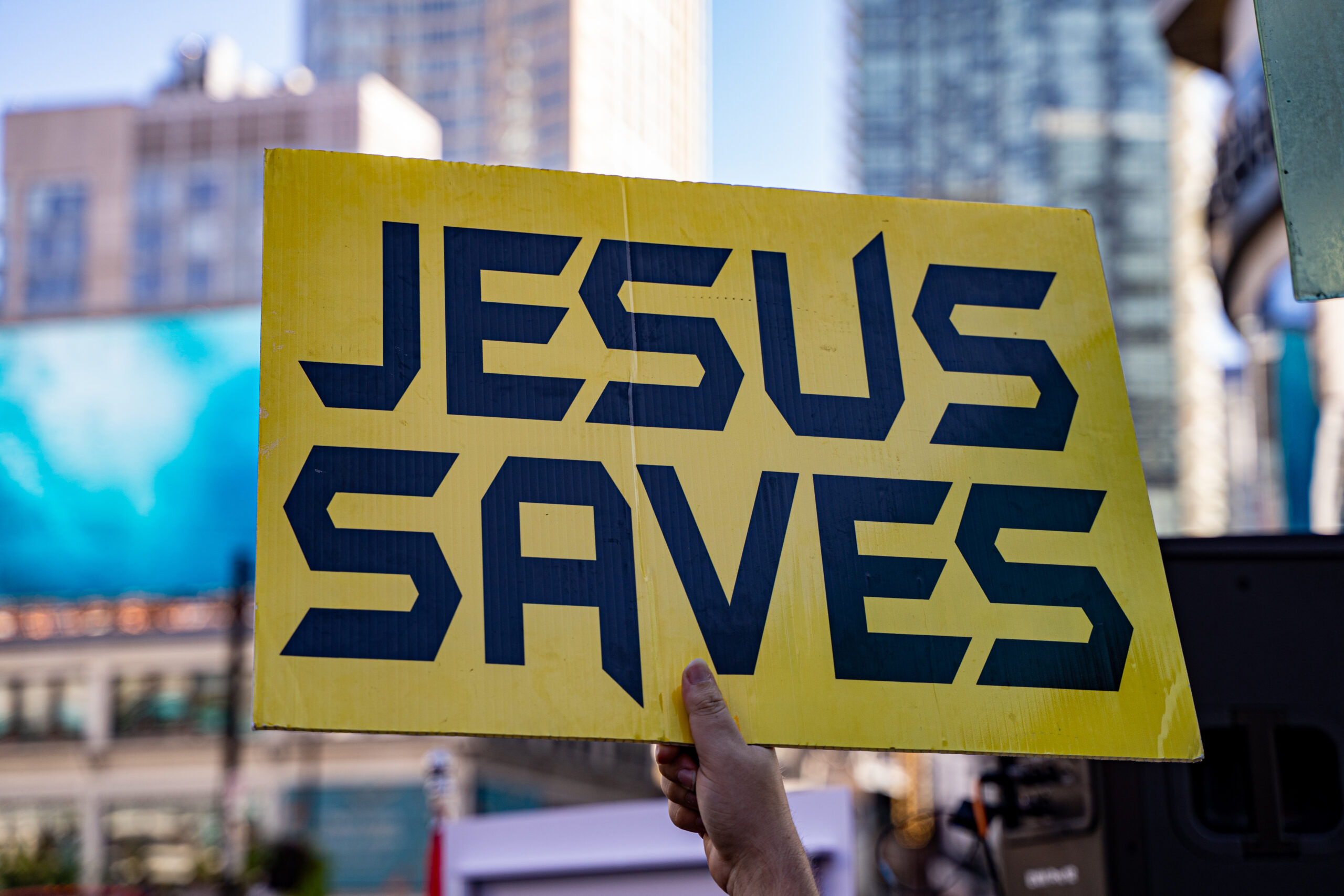
Gabriel Olivier is a Christian street preacher who believes that sharing his religious views with others is a fundamental aspect of his religion. He often stations himself outside event venues to speak to event attendees about Christianity and hand out religious literature. He also typically uses loudspeakers and signs to communicate his message.
Olivier traveled to Brandon, Mississippi, several times in 2018 and 2019 to share his faith on sidewalks near the city’s amphitheater. City officials described the protests as chaotic, with police sometimes needing to intervene to prevent fights between the group and amphitheater attendees. People attending concerts walked in the street to avoid the proselytizers.
In 2019, the city passed an ordinance requiring all individuals or groups engaging in “protests” or “demonstrations” stay within a “designated protest area” around the time the amphitheater had events scheduled. This area was about 265 feet away from the amphitheater. The ordinance also banned loudspeakers that could be heard more than 100 feet away and required signs to be handheld.
Mr. Olivier returned to Brandon in 2021 and, after finding the designated area too remote and isolated, returned to the sidewalks near the amphitheater. Police advised Olivier and his group to move to the designated area. Olivier declined and was arrested for violating the ordinance by preaching on the sidewalk in front of the amphitheater rather than in the designated protest area. He pleaded no contest and was sentenced to a fine and a year’s unsupervised probation.
Rather than contest his conviction, filed suit to challenge the constitutionality of the ordinance. Olivier used a federal civil rights law—42 U.S.C. § 1983—to sue the city, alleging the ordinance violated his First Amendment free speech rights. Olivier also sought an injunction prohibiting city officials from enforcing the ordinance in the future.
The city argued that because Olivier had been convicted of violating the same ordinance years earlier, the U.S. Supreme Court’s decision in Heck v. Humphrey, 512 U.S. 477 (1994), bars the suit. The Heck decision was intended to block people convicted of a crime from filing a civil suit that would, if successful, effectively let them undermine their conviction. If a court reviewing that civil suit found an underlying law unconstitutional, then people guilty of violating it would almost certainly seek to toss their conviction and punishment.
Following Heck, the federal district judge threw out the lawsuit, concluding that Olivier’s civil lawsuit challenging the city’s ordinance could not move forward. The Fifth Circuit Court of Appeals affirmed.
The Supreme Court granted cert. in the case. The issue for the court was not the constitutionality of the city’s ordinance, but rather whether Olivier could file a civil suit challenging the ordinance even though he had already been convicted of violating it. The Center for Law & Religious Freedom, on September 9, 2025, filed an amicus brief urging the Court to allow Olivier’s case to go forward because the lower court decisions infringed on his First Amendment rights.
On March 6, 2026, the Court ruled that Olivier’s challenge to the ordinance limiting protests and demonstrations around the city’s amphitheater to a designated area when events are scheduled at the amphitheater can move ahead. In a unanimous decision written by Justice Elena Kagan, the Court found that Heck does not bar Olivier’s suit because he is only seeking an injunction to prevent future enforcement of the ordinance. The fact that a victory in his suit would mean that his prior conviction was unconstitutional does not mean that the lawsuit barred.
Olivier isn’t challenging the validity of his conviction to get relief or to seek monetary damages, Justice Kagan wrote. Instead, he’s trying to protect himself from being prosecuted again for the same crime: “This suit, after all, is not about what Olivier did in the past, and depends on no proof addressed to his prior conviction,” Kagan said.
According to the opinion, the language in Heck “swept a bit too broad.” The Court’s concern in that case was with suits that “require[] looking back to conduct involved in a prior conviction, and offering contradictory proof,” rather than with a suit, like Olivier’s, that is “future-oriented—even if, as a kind of byproduct, success in it shows that something past should not have occurred.”
To hold otherwise, Kagan wrote, would be to force Oliver to choose between knowingly violating the ordinance and “risk[ing] another prosecution” or “forgo[ing] speech he believes is constitutionally protected.” The Court chose not to put Olivier to that choice.